
A Founder's Guide to Choosing Between Direct Buyers and Distributors
ExportGTM Editorial · Reviewed by ExportGTM Editorial Team · · 4 min read
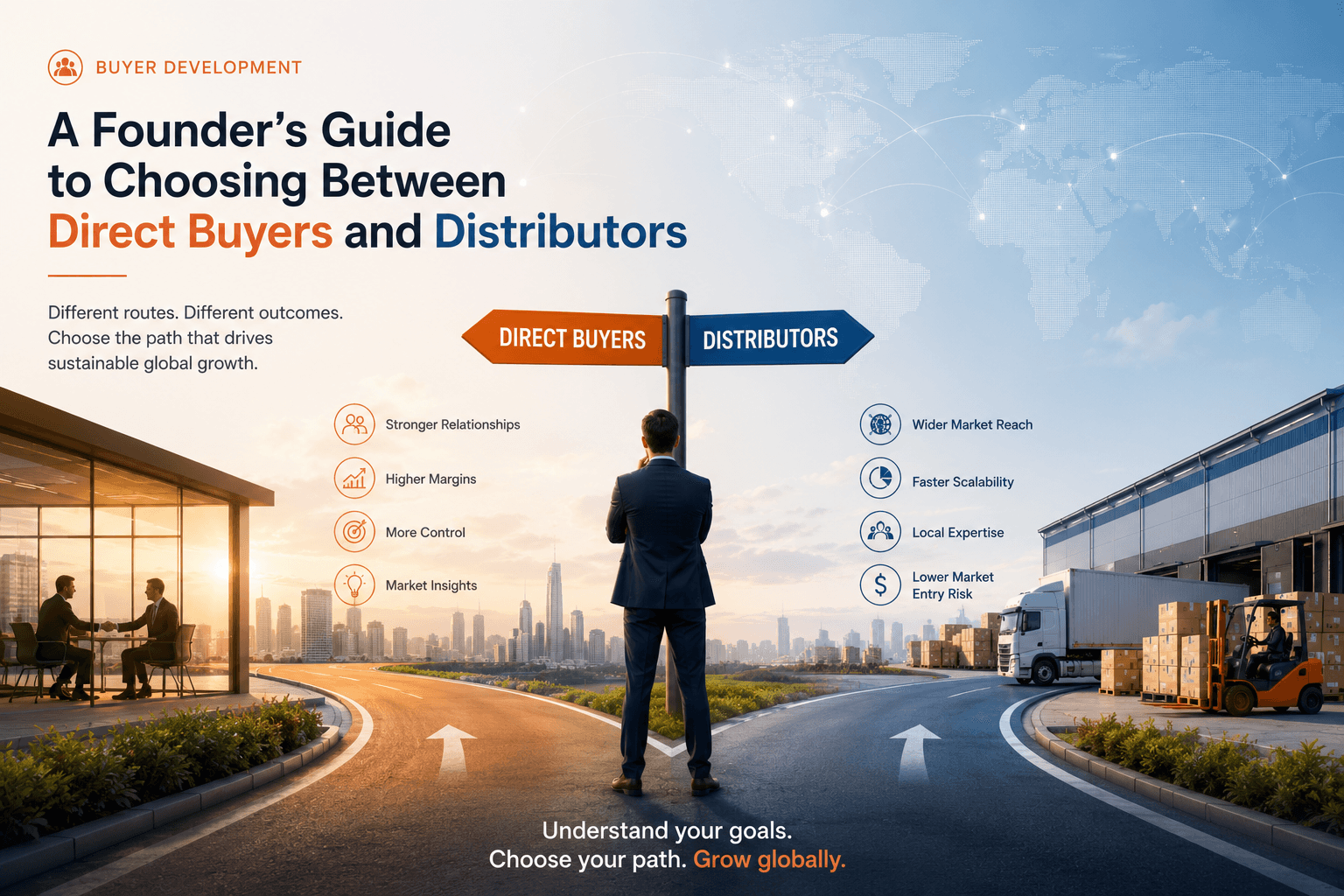
One of the first strategic calls a new exporter has to make isn't about pricing or product — it's about who you're actually selling to. Do you go after direct buyers (the end brand, retailer, or manufacturer that will use your product) or distributors (a local partner who buys from you and resells into their own network)? Founders often treat this as a values question — "direct is more profitable, so direct is better" — when it's actually a capacity question. Here's how to think about it properly.
What You Actually Give Up With a Distributor
The trade-off is real and worth naming plainly. A distributor takes a margin for the value they add, which means a lower per-unit return than a direct sale at the same price point. You also lose some direct visibility into the end customer — pricing decisions, positioning, and feedback all pass through an intermediary rather than reaching you first-hand. For founders used to owning every part of the customer relationship, this can feel like giving up control. It is — but that control has a cost, and the question is whether you can afford to pay it yet.
What You Actually Get From a Distributor
In exchange, a good distributor brings local market knowledge and existing buyer relationships that would otherwise take you years to build from India. Many also handle in-country logistics and warehousing, shortening the practical distance between your factory and a shelf or worksite abroad. In markets where registration or licensing is genuinely complex — certain pharmaceutical and regulated-product categories, for instance — a distributor with an existing registration track record can absorb overhead that would otherwise sit entirely on your team. The net effect is faster, lower-friction market entry, at the cost of margin and some control.
What Direct Buyer Relationships Actually Require
Going direct isn't simply the "better" choice sitting there for the taking — it requires real capacity you have to build or already have. That means sustained in-market outreach (whether through your own presence or consistent remote effort across time zones), the ability to manage logistics, customs, and local compliance yourself or through freight partners, and the patience for a longer sales cycle, since you're building buyer trust from zero rather than borrowing a distributor's existing credibility. It also means having enough team bandwidth to manage multiple direct relationships without any one of them going quiet from neglect.
The Real Question: What Does Your Team Have Capacity For Right Now?
Strip away the margin argument and the real question is one of honest capacity. Do you have the people, time, and working capital to manage direct relationships across time zones and regulatory systems today — or is a distributor's existing infrastructure worth the margin trade while you're still building export muscle? There's no universally correct answer, only an honest one for where your business actually is right now, not where you'd like it to be in two years.
It's Not Always One or the Other
Many successful exporters run a blended model: distributor-led in markets that are complex, heavily regulated, or unfamiliar, and direct in markets where they already have traction or a lower barrier to entry. The model can also evolve within a single market — starting distributor-led to establish credibility and learn the terrain, then shifting toward direct relationships once you've built enough in-market trust and infrastructure to justify the transition. Treating the choice as permanent, rather than a starting point you can revisit, is itself a common and avoidable mistake.
A Quick Gut-Check Before You Decide
If you're still unsure which way to lean, three honest questions usually surface the answer. Can your team currently respond to a buyer inquiry from a different time zone within a day, consistently, without it displacing everything else on someone's plate? Does your product sit in a category where local registration, certification, or licensing is complex enough that navigating it alone would meaningfully slow you down? And can your business absorb a slower path to revenue in exchange for keeping more margin and more control? Two or more "no" answers usually point toward a distributor for this market, at least for now. Two or more "yes" answers suggest you have the capacity to go direct and keep the margin that comes with it.
How We Help You Decide, Market by Market
Our Buyer Development service is built around mapping the realistic route to market for your specific product and target country, rather than defaulting to whichever model is easier to pitch. Sometimes the honest recommendation is "distributor first, direct later" — and we tell clients that plainly, because a route-to-market decision that matches your actual capacity closes more deals than one that matches your ambition alone.
Have a Question Specific to Your Product?
General guidance only goes so far. Tell us about your product and we'll give you a straight answer.