
UAE vs. Germany: Which Should Be Your First Export Market?
ExportGTM Editorial · Reviewed by ExportGTM Editorial Team · · 5 min read
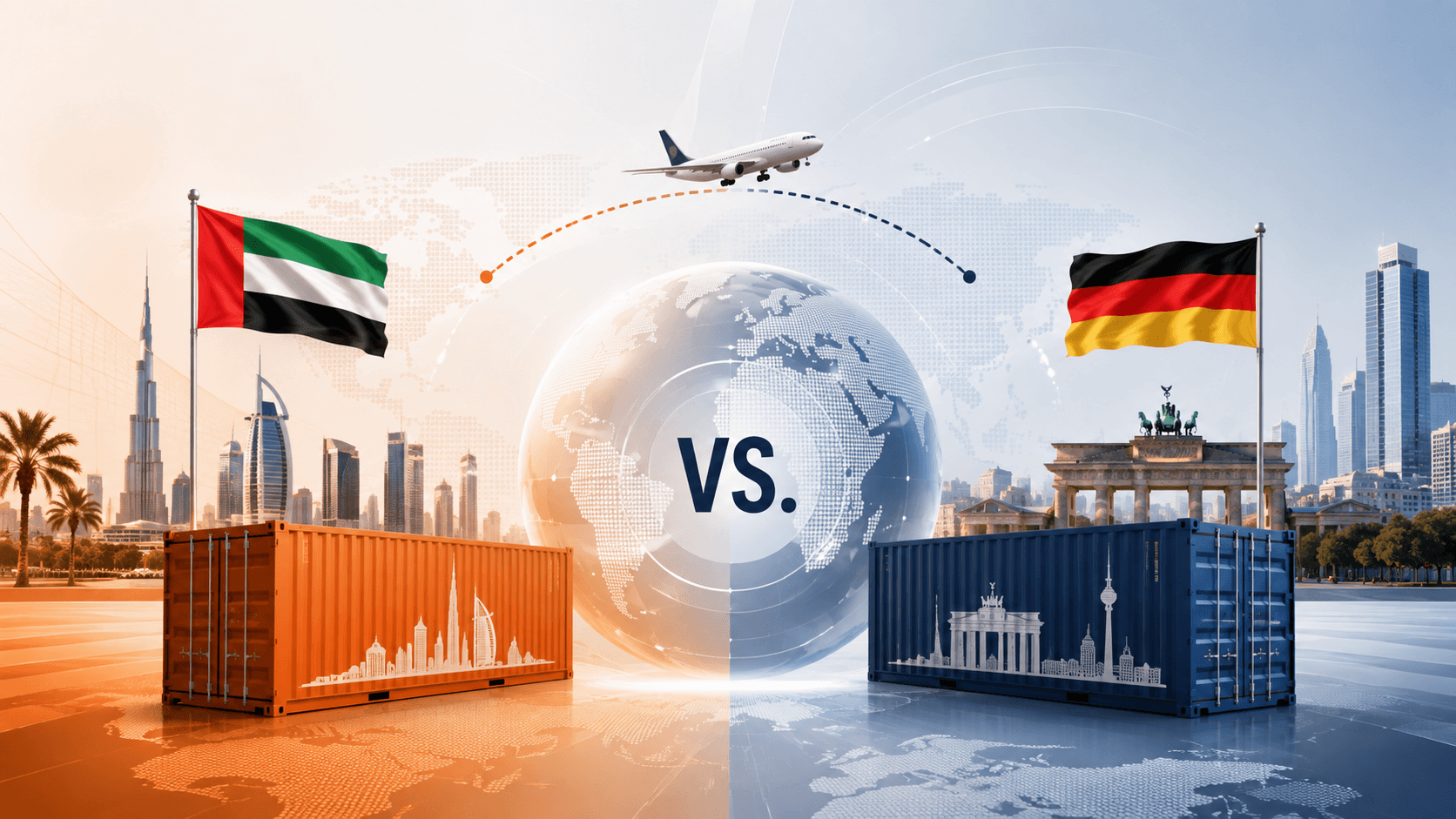
For an Indian manufacturer taking its first serious step abroad, the choice of first market matters more than almost any other early decision — and the two names that come up most often, the UAE and Germany, sit at opposite ends of the difficulty scale. The UAE is fast, familiar, and forgiving: strong India trade ties, quick buyer responses, comparatively light regulatory friction, and a re-export role that can quietly open the door to the wider GCC and Africa. Germany is the opposite — Europe's largest industrial economy, high-value and loyal once you're in, but demanding on quality documentation, CE marking, and the kind of ISO-backed reliability that German buyers treat as table stakes rather than a bonus.
The honest answer to "which first?" is that it depends on two things: how export-ready your documentation already is, and how much margin you need from your first market. If your certifications are still coming together and you want a win on the board fast, the UAE is usually the smarter first move — you learn how to actually run an export deal (pricing, LC terms, logistics) in a lower-stakes environment before you tackle a market that punishes mistakes. If you already hold the certifications German buyers expect and you're chasing durable, high-margin relationships rather than a quick order, Germany can reward the harder entry with far stickier business.
Documentation Readiness: The Real Deciding Factor
Before you weigh anything else, take an honest inventory of what you actually hold today. ISO 9001? A quality management system a German buyer would recognize? CE marking, if your product category needs it? If the answer is "some of it, and we're working on the rest," that's not a disqualifier — it's data. It tells you that a market like Germany, where documentation is the price of entry rather than a nice-to-have, will cost you months you don't have yet. A market like the UAE, where the bar is lower and the response times are faster, lets you generate real export experience — and real revenue — while your certifications catch up.
What a First UAE Engagement Actually Looks Like
Exporters who choose the UAE first are usually optimizing for speed and learning, not headline value. A typical first engagement runs through a distributor or local partner rather than a direct end-buyer relationship, because the UAE's re-export role means many of the buyers you'll meet are sourcing for onward distribution into the wider GCC or East Africa, not just the domestic market. Payment terms tend to open with letters of credit for a first order and can move to more flexible terms once trust is established. The compliance layer is real — product registration and conformity requirements vary by category — but it's narrower and faster to clear than the EU's directive-driven system, which is exactly why so many first-time Indian exporters land here before anywhere else.
What a First Germany Engagement Actually Looks Like
Germany asks more of you before the first order and gives more back after it. Expect buyers to ask for your quality management documentation before they ask about price, and expect the sales cycle to run longer — building trust with a German industrial buyer is closer to a partnership pitch than a transaction. CE marking, where it applies to your product category, needs to be sorted before serious conversations start, not during them. What you get in return is durability: German buyers who commit tend to stay, order consistently, and value reliability enough to absorb price increases that a lower-margin market would resist. It's a slower door to open, but it tends to stay open longer once it does.
Margin Is the Other Half of the Decision
Documentation readiness tells you how hard the door is to open. Margin need tells you whether it's worth opening yet. If your current cost structure only works at volume, and volume is what you need most right now, a market that opens faster — even at thinner margins to start — gets you moving. If you can afford to wait for the right buyer and your product supports a premium position, a market that pays for quality over speed is the better trade. Conflating the two — choosing a "premium" market you can't yet supply properly, or a "fast" market you'll outgrow in a year — is one of the most common first-market mistakes we see.
Don't Let Market Size Decide For You
What you should not do is choose based on market size alone. A bigger market with a wall of compliance in front of it can be a worse first move than a smaller, faster one you can actually enter this quarter. That's exactly the trade-off our Export Market Selection service scores explicitly — demand, competition, regulatory complexity, and speed to first sale, weighted for your specific product — so the decision is made on evidence, not instinct.
How We Help You Make This Call With Evidence, Not Instinct
This is exactly the trade-off our Export Market Selection service is built to resolve. We score each candidate market — UAE, Germany, or any other country on your shortlist — across demand, competitive intensity, regulatory complexity, and speed to first sale, weighted for your specific product and current certification status. You don't get a coin flip between two respectable-sounding markets. You get a ranked answer, with the reasoning behind it, so your first export market is a decision you can defend rather than a guess you're hoping pays off.
Have a Question Specific to Your Product?
General guidance only goes so far. Tell us about your product and we'll give you a straight answer.